

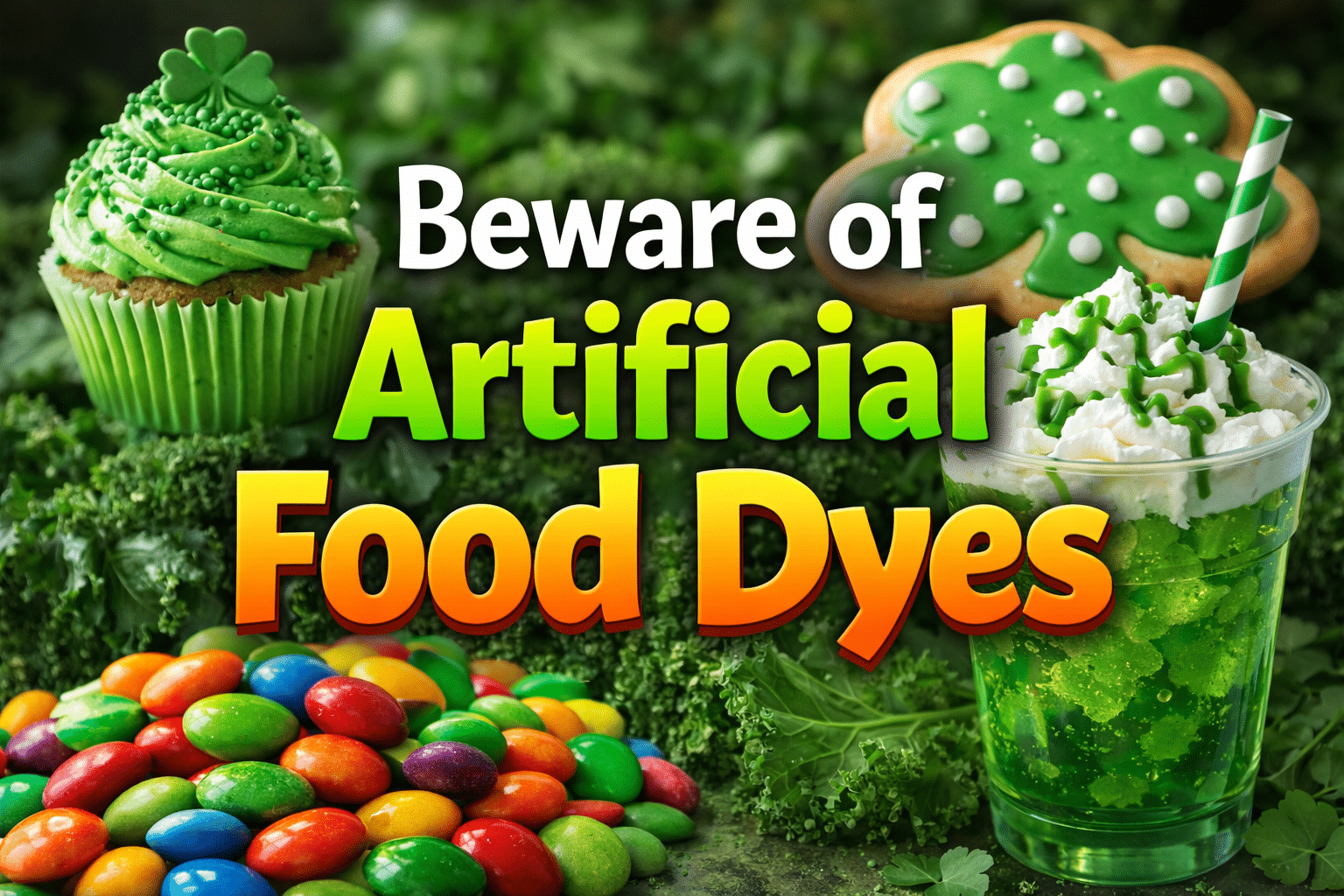
As St. Patrick’s Day approaches, grocery shelves and bakery displays are filling with festive green treats — from frosted cookies and cupcakes to brightly colored beverages. However, health experts say consumers may want to think twice before indulging in foods made with artificial green dyes.
Artificial food colorings are commonly used to enhance the appearance of processed foods. Green-colored items are often created by combining synthetic dyes such as Yellow 5 (tartrazine) and Blue 1 (brilliant blue), both approved for use by the U.S. Food and Drug Administration, but still debated among researchers and public health officials.

Emerging evidence on behavioral effects
Concerns about the potential impact of synthetic dyes on children’s behavior have grown in recent years. A 2007 study published in The Lancet found that mixtures of artificial food colorings and preservatives were associated with increased hyperactivity in children.
More recent research has strengthened those concerns. A 2022 review led by Miller et al., conducted for the California Office of Environmental Health Hazard Assessment, analyzed 27 clinical trials examining synthetic food dyes and behavioral outcomes in children. Of the 25 challenge studies reviewed, 16 (64%) found some evidence of a positive association between dye exposure and adverse behavioral effects, with more than half showing statistically significant results.
The review also incorporated findings from animal toxicology studies, which provided additional support for behavioral impacts. Researchers concluded that current acceptable daily intake levels may not adequately protect children who are more sensitive to these effects and called for further evaluation and updated safety thresholds.
In Europe, the European Food Safety Authority requires warning labels on certain artificial dyes stating they “may have an adverse effect on activity and attention in children.” The United States does not currently mandate similar labeling.
Ongoing safety questions
Scientific interest in synthetic food dyes continues to evolve. A 2024 review published in the journal Toxics noted that while regulatory agencies such as EFSA and the Joint FAO/WHO Expert Committee on Food Additives continue to monitor safety levels, many current acceptable daily intake limits are based on older data.
Researchers emphasized that newer toxicological evidence has emerged over the past decade and highlighted the need for updated assessments to better reflect real-world exposure and long-term health considerations.
Additionally, some individuals may experience sensitivities to certain dyes. According to the FDA, Yellow 5 has been linked to allergic-type reactions such as hives or asthma-like symptoms in susceptible individuals.
A shift toward natural alternatives
Growing consumer awareness has led to increased interest in naturally derived food colorings. Ingredients such as spinach, matcha, spirulina, and herbs can provide green coloring without synthetic additives.
Tips for a healthier celebration
Health professionals recommend simple steps to reduce exposure to artificial dyes during holidays:
- Check ingredient labels on baked goods, candies, and drinks
- Choose naturally colored options when available
- Prepare homemade recipes using plant-based ingredients
- Limit ultra-processed foods, which are more likely to contain synthetic dyes
Moderation and informed choices
Regulatory agencies maintain that approved dyes are safe within established limits. However, some experts advise a more cautious approach, particularly for children and individuals with sensitivities.
Increased awareness and small dietary adjustments can help families enjoy holiday traditions while making more informed food choices.
- U.S. Food and Drug Administration (FDA) – Color Additives Overview
https://www.fda.gov/food/food-additives-petitions/color-additives-questions-and-answers-consumers - European Food Safety Authority (EFSA) – Food Colours and Hyperactivity
https://www.efsa.europa.eu/en/topics/topic/food-colours - McCann, D. et al. (2007). Food additives and hyperactive behaviour in 3-year-old and 8/9-year-old children. The Lancet
https://doi.org/10.1016/S0140-6736(07)61306-3 - Miller, M. D. et al. (2022). Potential impacts of synthetic food dyes on activity and attention in children: a review of the human and animal evidence. Environmental Health, 21(1), 45
https://doi.org/10.1186/s12940-022-00849-9 - Amchova, P. et al. (2024). Food Safety and Health Concerns of Synthetic Food Colors: An Update. Toxics, 12(7), 466
https://doi.org/10.3390/toxics12070466


