

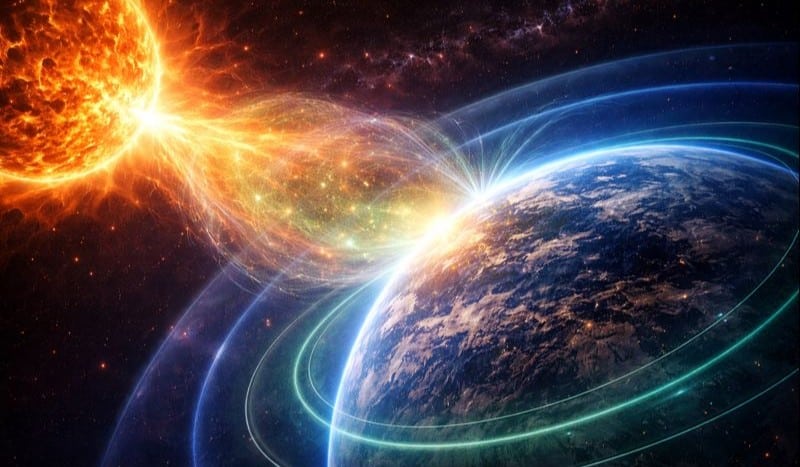
Seattle, Washington – A G4 (Severe) geomagnetic storm, in effect for Jan. 20, is expected to reach Earth, prompting increased monitoring of technology and critical infrastructure across the Pacific Northwest, federal space weather officials said.
According to the NOAA Space Weather Prediction Center, a coronal mass ejection, or CME, launched from the Sun late last week is forecast to arrive late Sunday into Monday. Severe geomagnetic storms can interfere with satellite operations, GPS accuracy, radio communications, and long-distance power transmission systems, particularly in regions with extensive infrastructure spanning large geographic areas.

The storm watch includes Washington, Oregon, Idaho, and western Montana, where utilities manage long transmission corridors connecting hydroelectric generation, population centers, and industrial users. While the Pacific Northwest lies south of the most geomagnetically vulnerable regions, officials say G4-level storms warrant close monitoring due to the region’s reliance on satellite-based navigation, aviation traffic, maritime operations, and wide-area power networks.
NOAA officials emphasize that widespread power outages are not expected. However, power providers and operators of critical systems typically take precautionary steps during severe solar storms, including enhanced grid monitoring and protective actions for sensitive equipment.
For most residents, the solar storm is unlikely to produce noticeable effects. Cell phone service and internet connectivity are expected to remain largely unaffected. Some users may experience minor GPS or navigation inaccuracies, which can affect aviation, marine navigation, surveying, and precision timing systems.
Aurora displays are possible across northern portions of the Pacific Northwest, particularly in Washington and northern Oregon, if geomagnetic activity intensifies beyond current forecasts.
Geomagnetic conditions may gradually ease into Tuesday as space weather activity subsides.


