

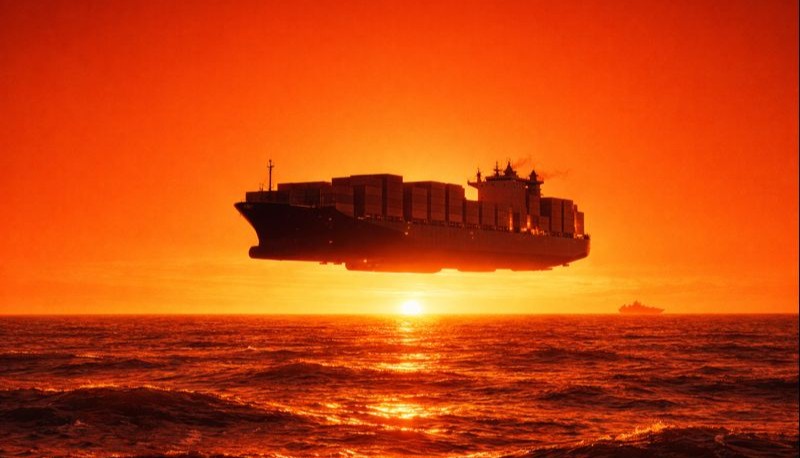
Mid-Atlantic Coast – Ships that appear to float or hover above the Atlantic Ocean horizon during spring and summer are a recurring sight along the Mid-Atlantic coastline, and scientists say the dramatic visuals are caused by a natural optical illusion.
The phenomenon, known as a superior mirage, occurs when cool air near the ocean’s surface becomes trapped beneath warmer air above it. This temperature inversion bends light downward toward the viewer, causing distant objects — including cargo ships, tankers, and offshore vessels — to appear elevated above their true position at sea.

Meteorologists say the Mid-Atlantic Coast, stretching from New Jersey through Delaware, Maryland, Virginia, and North Carolina, is especially prone to superior mirages during spring and early summer. Atlantic waters warm slowly after winter, while air temperatures rise more quickly inland and along the coast, creating the contrast needed to distort light. Calm mornings and late afternoons typically provide the clearest viewing conditions.
From beaches, boardwalks, barrier islands, and elevated coastal overlooks, ships may appear stretched vertically, duplicated, or suspended in midair. These visuals have led many observers to describe the phenomenon as “flying ships,” even though the vessels remain firmly on the ocean’s surface.
The distortion occurs as light travels through layers of air with different densities before reaching the eye. Long-distance viewing across open water and telephoto photography can intensify the illusion, making ships appear higher or more dramatic in photos and videos shared online.
In some cases, a more complex variation known as a Fata Morgana mirage can develop, producing rapidly shifting or stacked images that may change within seconds.
Coast Guard and maritime officials note the mirage does not interfere with navigation systems, which rely on radar and GPS rather than visual cues. However, visual estimates of distance can be misleading during these conditions.
For residents, students, photographers, commuters, and workers along the Mid-Atlantic Coast, the phenomenon serves as a reminder that along cold ocean waters, things are not always as they appear. As air temperatures stabilize later in the day, the “flying” ships typically return to their familiar place on the horizon.


