

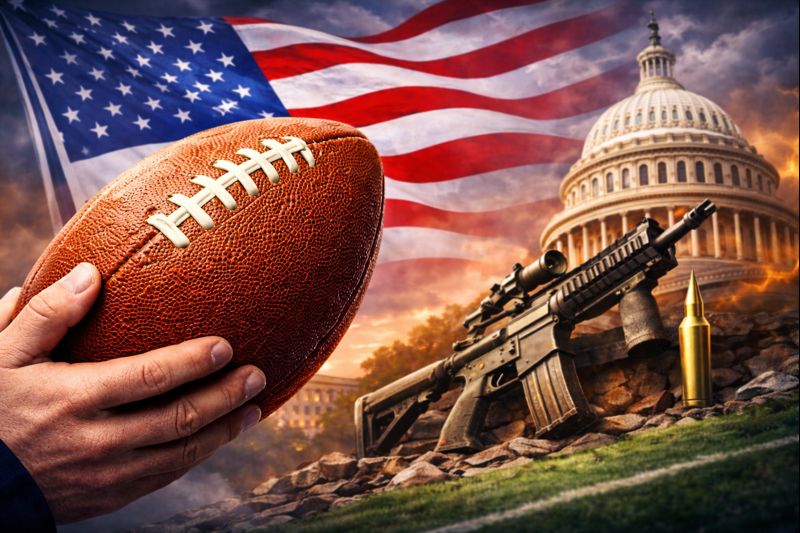
If you want to understand modern American confusion about rights, don’t start with a law book. Start with an NFL replay booth.
Every Sunday, millions of people watch professional referees slow reality down to frame-by-frame analysis and still shrug at a basic question: what is a catch? The ball moves. The ground is involved. The receiver has control—until he doesn’t. Officials cite rules no one can recite, overturn calls no one expected, and announce conclusions that satisfy almost no one.
Sound familiar?
A catch is supposed to be simple. Possession. Control. Completion. And yet the league has managed to turn a basic act—a man catching a football with his hands—into an unsolvable riddle. American constitutional rights are undergoing the same slow-motion erasure by confusion.
Rights are not suggestions. They are not conditional privileges dependent on who is in office or what mood the country is in. They are enumerated, written down, argued over, ratified, and defended. And yet today, many Americans are no longer sure what they are allowed to say, own, protest, or refuse.
We are told “rights evolve,” “rights are contextual,” or “rights mean different things now.” That may be true in academic seminars. But on the ground, ambiguity is power—and it rarely belongs to the citizen.
When reports circulate that foundational documents quietly disappear from official websites, or when political leaders speak as though long-established rights are optional or outdated, the message isn’t subtle: certainty is inconvenient. Vagueness allows enforcement without accountability, penalties without clear lines, and fear without explanation.
Meanwhile, irony piles up. NFL receivers are celebrated for using their arms to make impossible catches, while the country argues endlessly over who has the right to bear arms at all. Officials insist the rules are clear—even as they fail to define them consistently. Fans are told to trust the process. Citizens are told the same.
And just as the league’s biggest game approaches, the atmosphere grows tense—not only because of the stakes on the field, but because of the environment around it. Reports of heightened federal enforcement presence at major public events, particularly in diverse cities, raise a familiar question: is this about safety, or about signaling power? Security should reduce fear, not amplify it.
The collision is unavoidable. When rules are unclear, enforcement becomes arbitrary. When rights are vague, authority expands. When no one can definitively say what a “catch” is, fans get angry. When no one can definitively say what their rights are, citizens get quiet—or scared.
That’s the real danger.
A free society depends on shared understanding. You don’t need to agree with every right to recognize it. You don’t need to like every call to know the rule. But when the rulebook becomes flexible only for those in charge, trust evaporates.
So what are your rights?
They are not whatever the loudest voice says they are this week. They are not whatever survives a press conference. And they are not whatever remains after fear does its work.
A catch is a catch. Rights are rights. If we can’t define either, the game stops being fair—and the country stops being safe.
Know your rights. Demand clarity. And don’t let anyone tell you confusion is the same thing as progress.


