


West Lafayette, Indiana – A dinosaur that hasn’t taken a breath in roughly 150 million years is revealing new secrets thanks to technology normally used to diagnose Indiana’s pets and horses.
Last summer, teams from The Children’s Museum of Indianapolis arrived at Purdue University’s Veterinary Hospital carrying something highly unusual: real fossilized remains of an Allosaurus, still encased in dense, iron-rich sandstone. The fossil, discovered in Wyoming in 2020, was found in a rare articulated condition, meaning many bones remained aligned as they were in life.
That level of preservation creates both excitement and risk. According to museum paleontologists, removing surrounding rock without knowing what lies beneath could permanently damage fragile features, including possible fossilized skin or fine surface detail.
To solve that problem, the museum partnered with Purdue University College of Veterinary Medicine, tapping into advanced CT imaging technology typically used for animal patients. Inside the David and Bonnie Brunner Equine Hospital, veterinary diagnostic imaging specialists worked side-by-side with paleontology staff to plan the scans.
Test runs were first conducted on smaller rock samples to determine how best to image bone through solid stone. Once settings were finalized, the fossil—heavy, fragile, and irreplaceable—was carefully positioned inside the CT scanner.
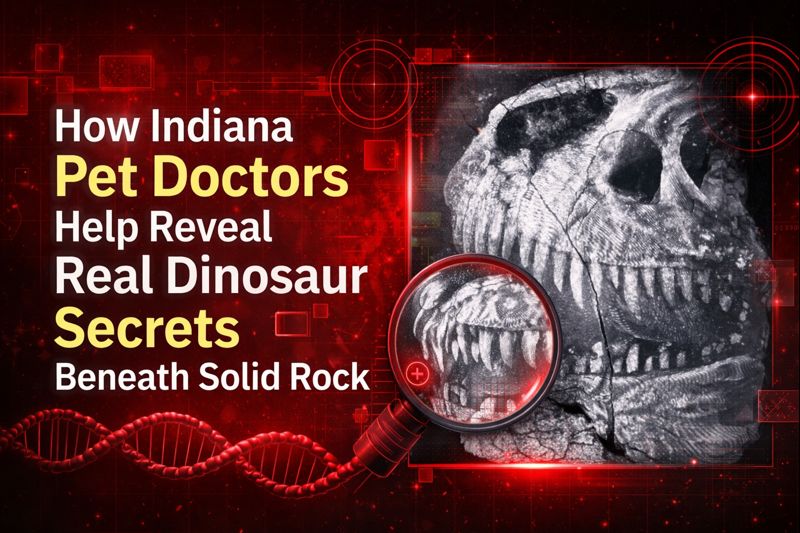
The results exceeded expectations. High-resolution images revealed internal anatomy hidden for millions of years, including replacement teeth still embedded inside the dinosaur’s jaw. Those scans now serve as a detailed roadmap, allowing preparators to remove rock with precision while preserving as much of the original fossil as possible.
The collaboration is a striking example of One Health in action, where medical expertise developed for pets and livestock helps unlock discoveries far beyond the veterinary world.
While the future Allosaurus exhibit will take several more years to complete, visitors don’t have to wait. Fossil preparation is already underway and visible to the public in the Paleo Lab at The Children’s Museum of Indianapolis, where a Jurassic predator is slowly emerging—guided by Indiana pet doctors and modern imaging science.
