News
Iowa Artists Float Water Quality Solutions with New Sculpture
Abstract editorial illustration for: Iowa Artists Float Water Quality Solutions with New Sculpture
AI Generated
Greg, the resident Highland cow at Wilson’s Orchard & Farm in Cumming, Iowa, witnessed an unusual scene unfolding one summer evening:
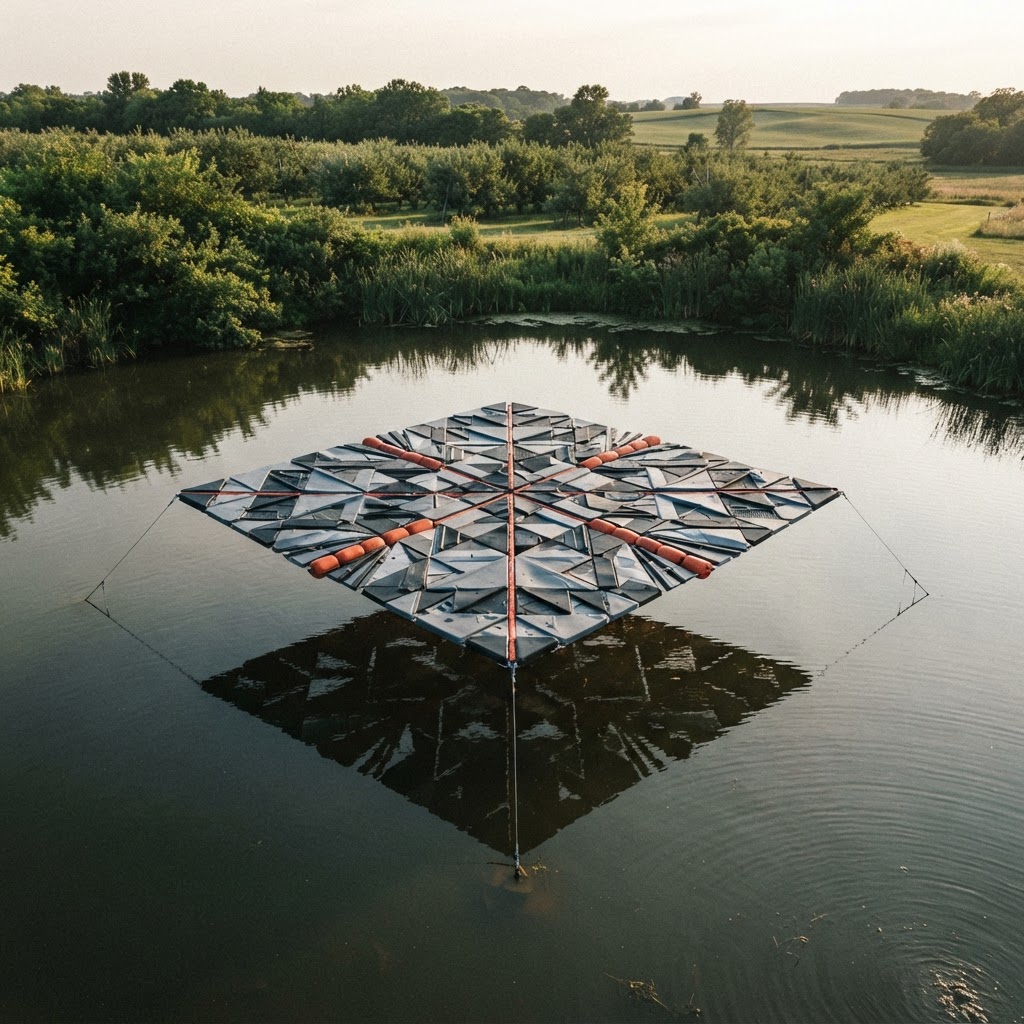
Artists Edward Kelley and Emily Newman needed extra hands to install their 18-by-18-foot functional floating sculpture. So, a cluster of people, some paddling canoes and others wading into the muck, maneuvered the massive artwork onto the regenerative farm’s shallow pond.
The launch party for their sculpture, It’s in the Water, became a truly immersive experience for everyone.

Artists Edward Kelley and Emily Newman of Parts Per Million Collective.
Site-Specific Solution
Modeled on a traditional quilt block design and made from dozens of reclaimed plastic fragments, It’s in the Water invites viewers dealing with drinking water concerns, beach closures, and the health consequences of agricultural runoff to consider creative solutions.
The environmental artwork is a visually compelling science experiment rooted in research. Buoys embedded within the sculpture mitigate pollutants through a simple biological process involving algae and sunlight.
“We’re advocating for at-the-source solutions,” Newman says. “That could be regulations for polluters, but also more conservation and reconstruction of Iowa’s wetlands, which are natural filters.”
A married couple with two children, Kelley and Newman both teach at Drake University, where Kelley is also pursuing environmental science and sustainability coursework. They team up on contemporary art projects as Parts Per Million Collective (PPMC), with a goal to advance direct action on environmental issues.
“I think the myth that artists are lone geniuses is dispelled when you take a look at the way we make work,” Newman says.
PPMC developed It’s in the Water for a site-specific summer public art exhibition curated by Group Creative Services. Organizers felt the sculpture could start conversations about a significant statewide challenge.
“Water quality and nitrates are a big topic right now,” says Siobhan Spain, who selected PPMC’s proposal and sourced the funding, location, and volunteers to make it possible. “I think people felt connected to the project because it made them think about the power that they have to make change.”
A 2026 Iowa Department of Natural Resources report listed more than 700 segments of rivers, lakes, or wetlands as “impaired” and in need of cleanup efforts. Central Iowa Water Works regional nitrate removal facility recently ran a record-setting 193 consecutive days. However, encouraging data from PPMC’s weekly water testing at the sculpture site suggests the sustainable farming practices Wilson’s put in place appear to be working.
Artists Edward Kelley and Emily Newman embedded nitrate-filtering devices within red, white, and blue recycled plastics arranged to reference quilt iconography for an art installation created to coincide with America 250 celebrations.
Community-Oriented Experimentation
Even before It’s in the Water arrived on-site at Wilson’s, community members contributed to its development and design. The sculpture’s nitrate-removal capabilities are based on technology invented by a team of Drake University students that Kelley mentored for a global OpenAir Carbon Removal Challenge.
“Art making and science are very related, in practice,” Kelley says.
PPMC takes inspiration from boundary-spanning creatives like Jean Tinguely, Alexander Calder, and Mary Miss. They also incorporated concepts they tested as artists-in-residence at Iowa Lakeside Lab. Located in northwest Iowa, Lakeside Lab is a biological field station and nature preserve. Their two or four-week residencies prioritize work that uniquely engages with ecology, science, and natural history.
Volunteers helped source secondhand toddler toys and beds, and stitched the plastic pieces into the quilt pattern.
The 18-by-18-foot functional floating sculpture is viewable through September from a walking path that winds from Wilson’s Ciderhouse Restaurant to the barn. The exurban property is about 20 miles southwest of Des Moines. Other installations in the “Declarations” series popped up at places like Whiterock Conservancy in Coon Rapids, Wallace Centers of Iowa in Orient, and the Clive Greenbelt Trail.
Funding for this It’s in the Water installation, which involves weekly monitoring of the sculpture’s “Semi Passive Algae Rooted Carbon Collector” (SPARCC) buoy systems, was provided by Fred & Charlotte Hubbell. Parts Per Million Collective hopes to establish additional partnerships that combine art and citizen science.
The floating sculpture, It’s in the Water, took the form of a ribbon star quilt.
“I like to counter that scientific component with things that are domestic and comforting,” Newman says.
This piece of purpose-built floating art took the familiar form of a ribbon star quilt to tie into ‘America 250’ timing. Volunteers helped source secondhand toddler toys and racecar beds from brands like Little Tikes and Step2 and stitched the plastic pieces into the quilt pattern. Involving their community in creating and launching their artwork offered practical benefits for a project on a tight installation deadline. It parallels the urgent need for environmental action.
“That’s also a metaphor for water quality issues,” Newman says. “We all have to work together.”
Source: Arts Midwest

Related coverage
Weather
Iowa Weather: 94° Peak Heat for Labor Day Weekend Travel Alert in Des Moines
Politics
Iowa congressional candidates offer opposing trade, affordability fixes

News
Child Raising and Art Making? These Iowans Do It All—Together
Weather
Des Moines, IA Weather: Heat Returns for Tuesday in Central Iowa

Weather
Northeast Iowa Storms Bring Wind and Hail Risk Through Sunset Friday
Weather
Quad Cities Heat Warning: Peak Heat Indices Reach 110 Degrees Through Saturday

Crime & Safety
Davenport: Three Men Sentenced to Federal Prison for Drug and Gun Crimes
Politics